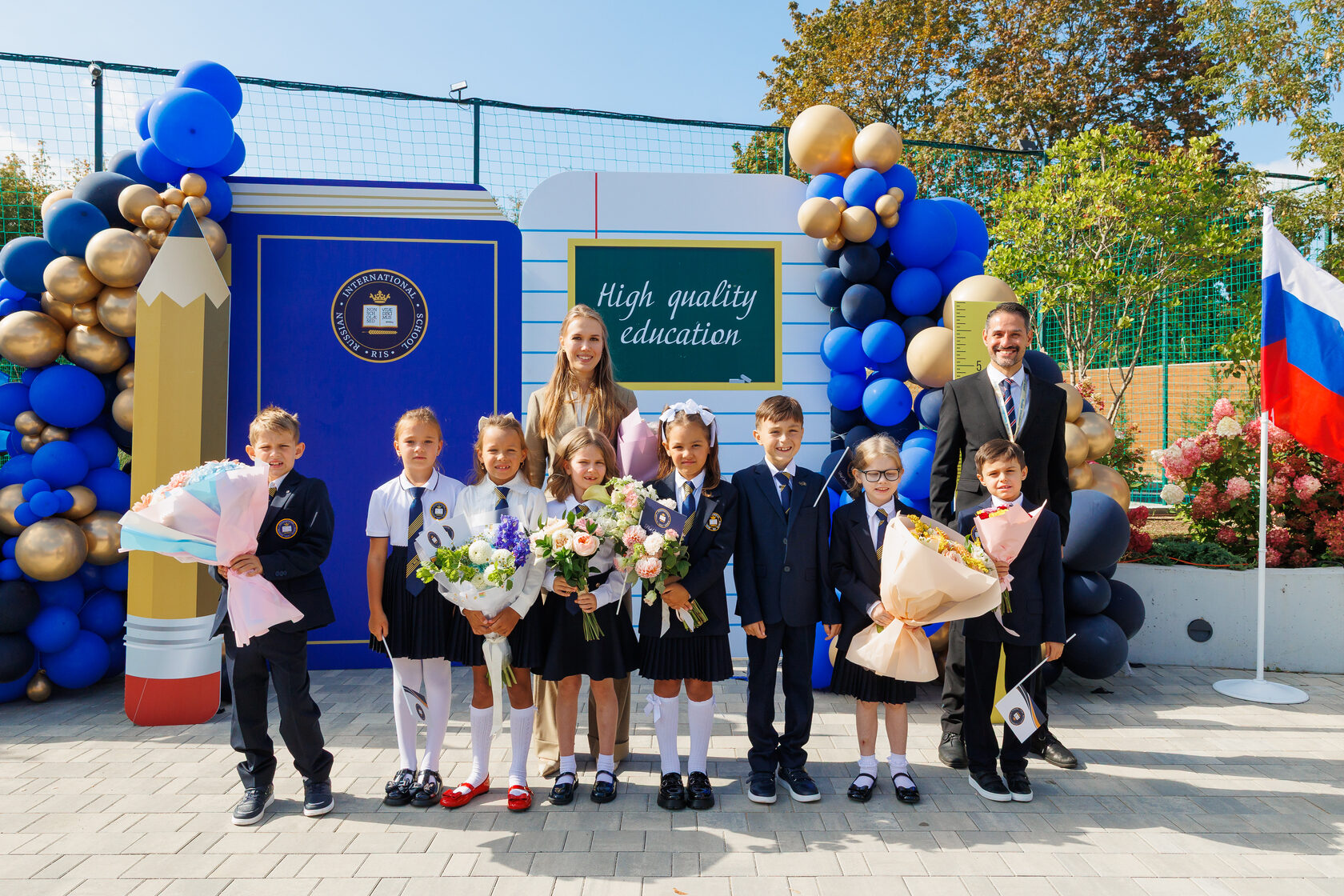
Most parents choosing a school in Moscow eventually run into the same fork in the road: go with a strong Russian school and hope an international pathway can be added later, or go fully international and risk a weaker connection to the Russian academic system. In 2008, Russian International School (RIS) was built specifically to remove that trade-off — as one of the first schools in Moscow to run a genuinely dual curriculum, combining a rigorous Russian academic programme with a fully accredited Cambridge and A-Level track, for the same students, on the same campus, from the same age.
Almost two decades later, "dual curriculum" has become a common phrase on Moscow school websites. It's worth being precise about what it actually means — and why doing it properly is harder than adding English lessons to a Russian timetable.
The Problem RIS Was Built to Solve
Before dual-curriculum schools existed in Moscow in any meaningful way, families generally had three options: a standard Russian school, a Russian school with an "enhanced English" track, or a fully international school taught entirely in English with little connection to Russian state standards.
Each came with a compromise. An enhanced-English track usually meant extra language lessons, not an internationally accredited qualification. A fully international school meant strong English-language outcomes, but a Russian diploma either wasn't offered or wasn't the focus — a real issue for families who might return to, or stay within, the Russian education and university system.
RIS's founding idea in 2008 was to stop treating this as an either/or choice. Instead of layering English classes onto a Russian curriculum, or squeezing Russian content into an international one, RIS built two parallel, fully resourced academic tracks — Russian state curriculum and Cambridge/Edexcel international curriculum — running side by side from early childhood through Sixth Form, taught by curriculum specialists in each system rather than generalists covering both.
What "Combining" Two Curricula Actually Involves
It's easy for a school to claim a dual curriculum. Delivering one requires structural commitments that are harder to fake:
Two separate accreditations, not one blended syllabus. RIS students work toward a Russian Ministry of Education-recognised qualification and an internationally recognised Cambridge International / Edexcel qualification — including GCSE and A-Level — as two distinct, externally validated pathways. Roughly 40% of RIS students currently graduate the Russian programme with honours, alongside their international results.
Specialist teachers on both sides. The international track is taught by an international faculty, including native English speakers from the UK and US, delivering the Cambridge curriculum as it's taught in Cambridge-accredited schools elsewhere in the world — not a translated version of a Russian syllabus. The Russian track is taught by Russian-curriculum specialists to full state standard. Neither side is a watered-down version of the other.
One school, not two half-schools. Students aren't split into an "international stream" and a "Russian stream" that rarely interact. They're part of one school community across RIS's campuses — the main Barvikha campus (primary through A-Level) and the early-years campuses in Zhukovka and Khamovniki — with both academic tracks running throughout their time at the school, not bolted on at a later stage.
Two diplomas at the end, not one plus a certificate. Graduates leave with a Russian state diploma and an internationally recognised Cambridge/Edexcel qualification, both of which stand on their own — one for pathways within Russia, one accepted by universities in the UK, the US, and elsewhere.
Why the Timing Matters
Being an early mover in dual-curriculum education in Moscow isn't just a historical footnote — it shows up in how mature the model is in practice. Two decades of running Russian and Cambridge/A-Level programmes in parallel means RIS has had the time to work out the practical questions that trip up newer dual-curriculum schools: how to schedule two full academic tracks without overloading students, how to support a child moving between systems mid-year, and how to keep both diplomas academically credible rather than treating one as decorative.
That's also reflected in scale: RIS now runs the model across three campuses — full primary-to-Sixth-Form provision in Barvikha, and dedicated early-years campuses in Zhukovka and central Moscow's Khamovniki district — allowing families to start their child on the dual track from nursery age rather than joining an international programme only once formal secondary schooling begins.
Who This Model Is Actually For
A dual Russian–Cambridge curriculum tends to matter most to three kinds of families:
Families who aren't yet sure whether their child's education — or university years — will happen in Russia, abroad, or both, and don't want that decision locked in by age 10.
Expat and internationally mobile families who want a Russian-recognised education for a child growing up in Moscow, without giving up an internationally portable qualification if the family relocates again.
Families who simply want both doors held open — a strong Russian academic foundation and English international qualification, without treating either one as the "backup" option.
Frequently Asked Questions
Is RIS the first school in Moscow to offer both a Russian and an international curriculum? RIS was founded in 2008 as one of the earliest schools in Moscow to combine a full Russian state curriculum with a fully accredited Cambridge/A-Level international curriculum for the same students, rather than offering an "English-enhanced" version of a single track. Other schools have since developed similar dual-curriculum models.
What's the difference between a "bilingual" school and a dual-curriculum school? A bilingual school typically teaches some subjects in English without leading to an internationally accredited qualification. A dual-curriculum school like RIS runs two fully accredited academic programmes in parallel — Russian state curriculum and Cambridge/Edexcel — each assessed and certified independently, resulting in two diplomas rather than one diploma with English-language instruction.
Does my child need to be fluent in English to join the international track? Instruction on the international track is in English, delivered by native and international teaching staff, alongside the Russian-language track. Specific placement and language support depend on a child's current level — this is best discussed directly with the admissions team during a tour.
Can a child join the dual programme partway through school, or only from nursery? RIS's early-years campuses in Zhukovka and Khamovniki allow children to start the dual track from age 2, and the Barvikha campus carries it through to A-Level, but the school also accommodates students joining at other ages — placement depends on the child's current academic level in each track.
Do universities abroad recognise the Cambridge/A-Level diploma from RIS? Yes. RIS's international track is accredited by Cambridge Assessment International Education and Edexcel/Pearson, the same examination bodies used by Cambridge-curriculum schools worldwide, and A-Level results are widely accepted for university admission in the UK, the US, and elsewhere.
To see how the dual curriculum works day to day — timetables, faculty, and how the two academic tracks fit together on one campus — the admissions team can arrange an in-person or virtual tour. Contact RIS at +7 (495) 974-04-55 or mail@rischool.info.